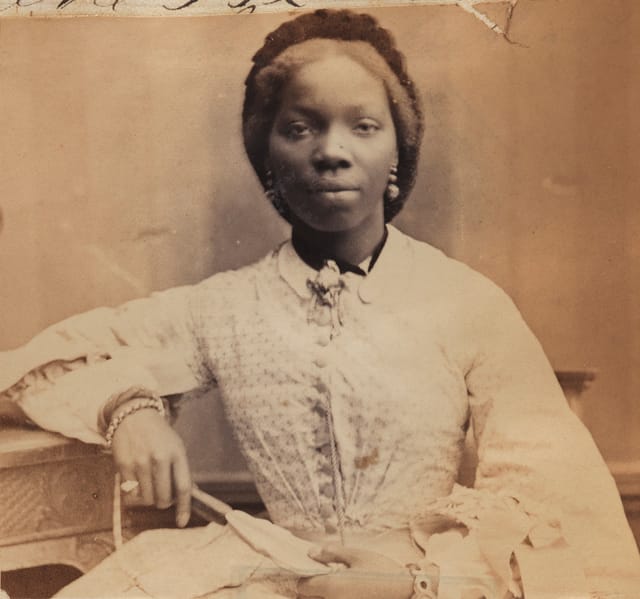
Wikimedia Commons / Camille Silvy / National Portrait Gallery / Public Domain
Sara Forbes Bonetta
Born Aina in Yorubaland around 1843, she was orphaned in the Dahomey slave raids, then given to Queen Victoria as a gift by King Ghezo of Dahomey. She became a remarkable figure in Victorian England, educated and cultured, yet always defined by her origins. Her life illuminates the complexity of African identity under colonialism.
Biography
Sara Forbes Bonetta was born around 1843 in Yorubaland, in what is now southwestern Nigeria. Her birth name was Aina. When she was about five years old, her family was caught up in the slave raids of the Kingdom of Dahomey. Her parents were killed; she was taken to the court of King Ghezo.
In 1850, Captain Frederick Forbes of the Royal Navy arrived in Dahomey on a diplomatic mission. Ghezo presented the young girl to Forbes as a "gift" for Queen Victoria, framing it as a gesture of goodwill. Forbes accepted, renamed her Sara Forbes Bonetta (after his ship and himself), and brought her to England. Queen Victoria took an interest in her, paid for her education, and became her godmother.
Historical Context
The mid-19th century was a period of intense colonial expansion in West Africa. The slave trade was in decline but not yet abolished everywhere. European powers were carving up the continent. Dahomey was a powerful kingdom that had built much of its wealth on the slave trade; presenting a child to the British Crown was both a diplomatic gesture and a reflection of the brutal power dynamics of the era.
In Victorian England, Black people were rare in elite circles. Sara was an exception. She was educated, accomplished, and moved in high society. But she was always seen through the lens of her origins: as an exotic curiosity, a rescued savage, or a symbol of imperial benevolence.
What She Fought For
Sara Forbes Bonetta did not choose her path. She was taken, renamed, and remade. What she did was survive and thrive within the constraints imposed on her. She learned English, music, and the manners of Victorian society. She married Captain James Davies, a Yoruba man who had also been brought to Britain, and had children.
Her life raises difficult questions. She was "rescued" from one form of captivity only to be placed in another: the custody of the British Crown. She had no real autonomy. Yet she made a life, built a family, and left a legacy. Her story is one of resilience in the face of forces that sought to erase her identity and control her fate.
Major Achievements
- Became a protégée of Queen Victoria and was educated at royal expense
- Fluent in English and accomplished in music and the arts
- One of the few Black women in Victorian high society
- Married Captain James Davies in a wedding attended by royalty
- Her portrait was taken by Camille Silvy, one of the leading photographers of the era
- Her descendants include prominent figures in Nigerian and British society
Her Impact Today
Sara Forbes Bonetta's life is a reminder that African history under colonialism is not a simple story of victimhood or triumph. She was neither fully free nor fully erased. She navigated a world that saw her as an object of curiosity while building a life of dignity and accomplishment. Her story continues to be studied and retold as part of the broader history of African women in the diaspora and the complex legacies of empire.
Sources: Wikipedia (Sara Forbes Bonetta), National Portrait Gallery, Victoria and Albert Museum, Black Victorians (exhibition)
Know an African woman whose story should be here?
Suggest a woman