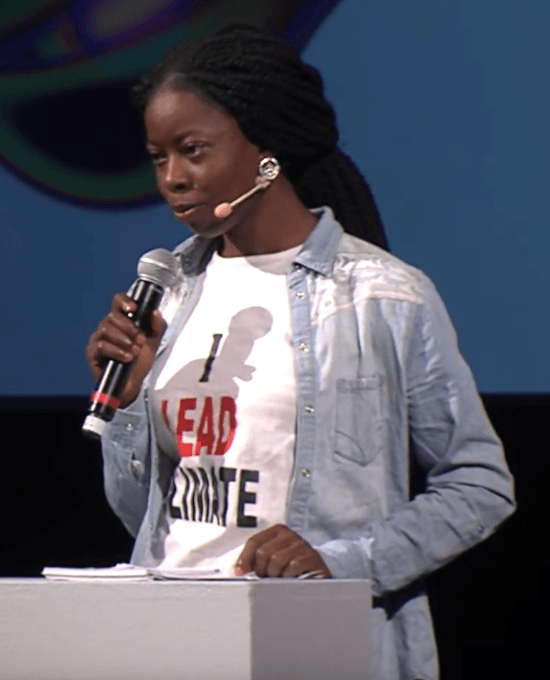
Wikimedia Commons / Elevate Festival / CC BY 2.0
Adenike Oladosu
Nigerian climate activist and the first African woman to lead a Fridays for Future climate strike. Campaigns tirelessly for the drying Lake Chad basin, a slow-moving environmental disaster affecting 40 million people across four countries. Named one of the most influential climate voices of her generation.
Biography
Adenike Oladosu was born in 1994 and grew up in Ilorin, Kwara State, Nigeria. She studied environmental management at the University of Ilorin, where she first began to connect the environmental degradation she saw around her (desertification, water scarcity, displacement) to the global crisis of climate change.
Her focus became Lake Chad: one of the world's largest freshwater lakes, which has shrunk by approximately 90% since the 1960s due to a combination of climate change, irrigation demands, and population growth. The lake's decline has devastated livelihoods across Nigeria, Niger, Chad, and Cameroon, drying out fishing communities, pushing herders onto farmland, and fuelling conflict. It is one of the starkest and most overlooked climate disasters in the world.
Oladosu decided to speak about it.
Historical Context
The climate activism movement gained global momentum in 2018–2019, largely driven by Greta Thunberg and the Fridays for Future school strikes. But the movement's coverage was heavily weighted toward the Global North. The communities most devastated by climate change (in sub-Saharan Africa, South Asia, the Pacific Islands) were largely absent from the mainstream conversation.
Adenike Oladosu moved to change that.
What She Fought For
In January 2019, Oladosu organised the first Fridays for Future climate strike in Africa, holding it in Ilorin, Nigeria. She became the face of African climate activism at a moment when the movement desperately needed African voices.
She has since addressed international audiences at multiple COP climate summits, the UN, and global youth climate forums, consistently refocusing attention from abstract emissions targets to the concrete human costs playing out in communities around Lake Chad. She speaks about climate not as a future threat but as a present catastrophe: communities already displaced, farmers already failing, children already hungry.
Her message is unflinching: the Global South is paying with lives for carbon produced mostly by wealthy nations.
Major Achievements
- Organised the first Fridays for Future climate strike in Africa (Ilorin, Nigeria, 2019)
- Represented Africa at multiple COP climate summits
- Spoke at the UN General Assembly side events and international climate forums
- Named one of BBC's 100 Women (2019)
- Women4Climate mentorship programme ambassador
- Featured in international media including Time, The Guardian, BBC, Al Jazeera
- Founder, i4G (Innovate for Green), a youth-led climate solutions initiative
Her Impact Today
Adenike Oladosu has put the Lake Chad crisis on the global map and made it impossible for international climate negotiations to ignore African perspectives entirely. She represents a new generation of Nigerian and African climate advocates who are not waiting for governments or international bodies to notice them. They are showing up and demanding to be heard.
She continues to organise, speak, and train young climate activists across Nigeria and the African continent.
Sources: Wikipedia (Adenike Oladosu), BBC 100 Women (2019), UN Climate Summit coverage, The Guardian
Know an African woman whose story should be here?
Suggest a woman