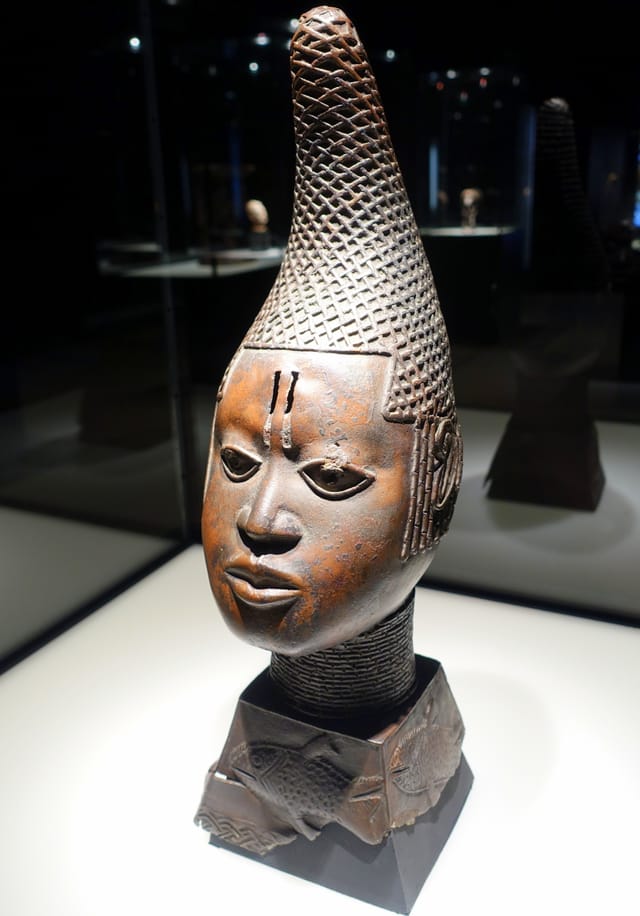
Wikimedia Commons / Memorial bust, Ethnological Museum Berlin / CC BY-SA 3.0
Queen Idia of Benin
Powerful 15th/16th-century Queen Mother of the Benin Kingdom (modern Nigeria). The first woman to hold the title of Iyoba (created for her by her son, Oba Esigie) in recognition of her military and political role in securing his throne. Her face lives on in the iconic Benin ivory mask, now at the British Museum, and at the centre of a decades-long repatriation debate.
Biography
Queen Idia lived in the late 15th and early 16th centuries in the Benin Kingdom, a powerful West African state in what is now Edo State, southern Nigeria. The Benin Kingdom at its height was one of the most sophisticated states in Africa, with a complex court hierarchy, an advanced artistic tradition in bronze and ivory, and a military capable of projecting power across a wide region.
Idia was the mother of Oba Esigie, who became the ruler of Benin in the early 16th century. What made Idia exceptional was not simply her role as royal mother but her active political and military participation in securing and defending her son's reign.
Historical Context
The Benin Kingdom was engaged in intense internal and external power struggles during Esigie's rise to the throne. Esigie faced challenges from his brother Arhuaran, who had the support of the Iyase (the kingdom's most senior warrior chief). He also faced external military pressure from the Igala Kingdom to the north, which invaded Benin's territory.
Into both crises, Idia stepped, not as a bystander but as a strategist and fighter.
What She Fought For
According to Benin court traditions and oral histories, Idia played a decisive role in defeating the Igala invasion. She is described as having raised, organised, and led forces against the Igala army, using both military organisation and mystical powers (she was said to be a skilled practitioner of spiritual arts). She fought to preserve the Benin Kingdom and to secure her son's power.
In recognition of this extraordinary contribution, Oba Esigie created a new title for her: Iyoba, Queen Mother. This position had never existed before. Idia became the first woman in Benin history to hold a formal political role at the highest level of the kingdom. The Iyoba had her own palace, her own court, her own retinue, and her own political voice.
Her power was real, not ceremonial.
The Ivory Mask
Queen Idia is immortalised in one of the most famous objects in African art history: the Benin Ivory Mask, carved in the 16th century. The mask depicts her face with striking detail, surrounded by a crown of Portuguese heads, a symbol of Benin's complex trade relationships with European merchants. The mask is regarded as one of the finest examples of Benin court art ever created.
Two versions of this mask exist. The primary version is held at the British Museum in London, acquired during the British Punitive Expedition of 1897, in which British forces looted and burned Benin City. A second version is held at the Metropolitan Museum of Art in New York.
The repatriation of the Benin Bronzes (including this mask) has been one of the most prominent debates in global museum ethics. Nigeria has formally requested the return of these objects for decades. In 2022, the Smithsonian and several European museums began returning some pieces. The British Museum, as of 2025, continues to hold the primary Idia mask.
Major Achievements
- First Iyoba (Queen Mother) of the Benin Kingdom, a position created in her honour
- Led military forces against the Igala invasion, credited with preserving Benin's sovereignty
- Immortalised in the Benin Ivory Mask, one of Africa's most iconic works of art
- Her image became the logo of FESTAC '77 (the Second World Black and African Festival of Arts and Culture), an event that brought together 59 nations in Lagos
- Her legacy anchors ongoing global debates about colonial looting and repatriation
Her Impact Today
Queen Idia's face (rendered in ivory six centuries ago) is one of the most recognised symbols of African heritage in the world. Her story is a story of female power in pre-colonial Africa that colonialism tried to erase, both by dismantling the Benin Kingdom and by looting its art. The ongoing fight for the return of the Benin Bronzes is, in part, a fight to restore that history to its people.
Sources: Wikipedia (Idia, Benin Kingdom), British Museum records, Encyclopædia Britannica, FESTAC '77 archive, Benin court oral traditions
Know an African woman whose story should be here?
Suggest a woman