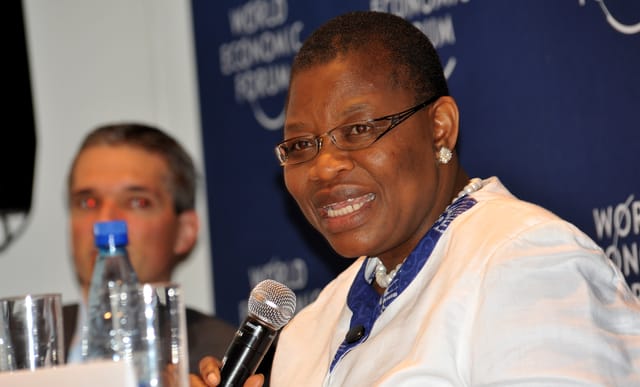
Wikimedia Commons / World Economic Forum / CC BY-SA 2.0
Obiageli Ezekwesili
Nigerian economist, public servant, and global advocate for education and accountability. Co-founder of Transparency International Nigeria, Vice President of the World Bank for Africa, and Nigeria's Federal Minister of Education. Co-launched the #BringBackOurGirls campaign in 2014 after the Chibok kidnappings, a global movement that changed how the world talks about violence against girls.
Biography
Obiageli Katryn Ezekwesili (known as Oby) was born on 28 December 1963 in Anambra State, Nigeria. She studied law at the University of Nigeria, Nsukka, later earning a master's degree in international law and diplomacy from the University of Lagos, and a master's in public administration from Harvard University's Kennedy School of Government.
She built a career across law, civil society, international development, and government, consistently focused on one question: why do African countries with abundant resources remain poor? Her answer, consistently, has been: corruption, weak institutions, and the failure to invest in people.
Historical Context
Nigeria in the 1990s and 2000s was grappling with the aftereffects of decades of military rule, widespread corruption, and chronic underinvestment in public services. Transparency International ranked Nigeria among the most corrupt countries in the world. At the same time, structural adjustment programmes, rising debt, and weak governance meant that oil wealth was consistently failing to reach ordinary Nigerians.
Oby Ezekwesili chose to fight that system from the inside, and from the outside.
What She Fought For
In the late 1990s, Ezekwesili co-founded Transparency International Nigeria, bringing the global anti-corruption network's rigour and tools to Nigeria's civil society at a critical democratic moment.
Under President Olusegun Obasanjo, she served as Special Assistant on Budget Monitoring and Price Intelligence and led the Due Process Office, a mechanism that saved Nigeria billions by scrutinising government contracts for corruption and inflated costs. She brought a prosecutorial energy to government procurement.
She then served as Federal Minister of Solid Minerals Development (2005–2006) and Federal Minister of Education (2006–2007), where she launched reforms aimed at improving school quality, teacher training, and accountability in a vastly underfunded sector.
From 2007 to 2012, she served as Vice President of the World Bank for Africa, one of the most senior positions in the institution, overseeing development lending and policy across the continent.
In April 2014, following the kidnapping of 276 schoolgirls from Government Secondary School Chibok, Borno State, by Boko Haram, Ezekwesili took to the streets of Abuja. She co-founded the #BringBackOurGirls campaign, which became a global movement, trended worldwide, and was amplified by everyone from Michelle Obama to Malala Yousafzai. It kept international pressure on the Nigerian government and forced accountability onto what might otherwise have been a forgotten atrocity.
In 2019, she ran for President of Nigeria.
Major Achievements
- Co-founded Transparency International Nigeria
- Led Nigeria's Due Process Office, saving billions through procurement reform
- Federal Minister of Education, Nigeria (2006–2007)
- Vice President, World Bank (Africa Region) (2007–2012)
- Co-founded and led the #BringBackOurGirls campaign (2014)
- Harvard Kennedy School alumna; multiple honorary degrees
- Presidential candidate, Nigeria, 2019: first major female presidential contender
- Named among Time magazine's 100 Most Influential People
Her Impact Today
Obiageli Ezekwesili remains one of the most prominent advocates for accountability, education, and child rights in Africa. The Chibok girls were never fully returned, but the campaign she helped ignite changed the global conversation around girls' education and Boko Haram's campaign of violence. She continues to speak, write, and campaign, refusing to allow the Nigerian government or the international community to move on.
Sources: Wikipedia (Obiageli Ezekwesili), World Bank official biography, #BringBackOurGirls campaign, Harvard Kennedy School
Know an African woman whose story should be here?
Suggest a woman