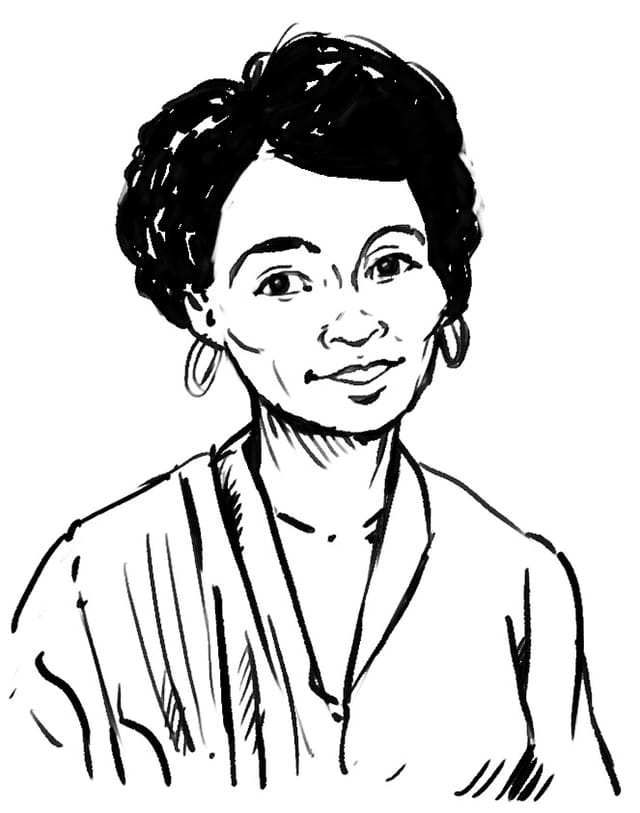
Wikimedia Commons / Public Domain
Margaret Ekpo
Nigerian women's rights activist and pioneer politician who mobilised thousands of women in Eastern Nigeria during the independence era, breaking into a political system designed to exclude them.
Biography
Chief Margaret Ekpo was born on 27 June 1914 in Creek Town, in what was then the Nigeria Protectorate. She came of age during British colonial rule and received her education in Ireland at the Dublin Institute of Technology, one of very few Nigerian women of her generation to receive higher education abroad.
She married John Udo Ekpo and settled in Aba, Eastern Nigeria, where she would spend decades building one of the most effective women's political organisations in the country's history.
Historical Context
Nigeria's path to independence in 1960 was shaped by nationalist politics that were, despite their anti-colonial rhetoric, largely dominated by men. Political parties sought women's support at election time but offered women little in return: no seats at the table, no power to shape policy.
Eastern Nigerian society, shaped by both Igbo and Efik traditions and colonial structures, offered women significant roles in market economies and community leadership, but not in formal politics. Margaret Ekpo changed that.
What She Fought For
Ekpo built the women's wing of the National Council of Nigeria and the Cameroons (NCNC) into a formidable political force in Eastern Nigeria. She was a grassroots organiser who spoke directly to market women, farmers, and community leaders, using the language and concerns of ordinary Nigerian women, not elite politics.
She led demonstrations, organised boycotts, and mobilised tens of thousands of women to participate in the independence struggle, not as supporters of men's agendas, but as political actors with their own demands.
In 1961, she was elected to the Eastern Region House of Assembly, one of the first women to sit in a Nigerian regional legislature. She used that platform to push for women's inclusion at every level of Nigerian public life.
Major Achievements
- Elected to the Eastern Region House of Assembly (1961), one of Nigeria's first female legislators
- Extraordinary Member of the Eastern Region House of Chiefs (1959–1961)
- Built the NCNC women's wing into a mass movement
- Awarded the Commander of the Order of the Federal Republic (CFR) and Officer of the Order of the Niger (OON)
- Titled Ezinne of the Igbo people and Obong-awan of the Efik people
- Trained in law and social welfare in Ireland
Her Impact Today
Margaret Ekpo died on 21 September 2006, aged 92. Her life spanned colonial Nigeria, independence, military rule, and the return of democracy. Throughout it all, she insisted that Nigerian women were not bystanders in their country's history. They were its makers.
Her name is honoured in Aba and Calabar. Her legacy is every Nigerian woman who runs for office, votes, or organises.
Sources: Wikipedia (Margaret Ekpo), Nigerian National Assembly Records, Encyclopædia Britannica
Know an African woman whose story should be here?
Suggest a woman