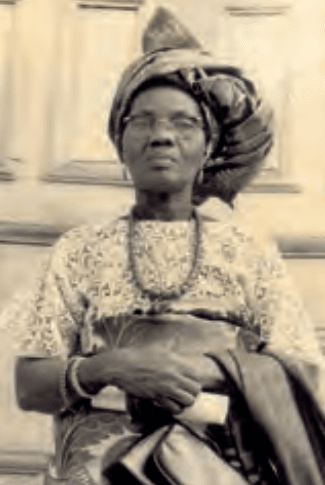
Wikimedia Commons / Public Domain
Funmilayo Ransome-Kuti
Nigerian activist who led the Abeokuta Women's Union, fought colonial taxation, and became the first woman to drive a car in Nigeria. Mother of Afrobeat legend Fela Kuti.
Biography
Frances Abigail Olufunmilayo Olufela Folorunso Thomas, known to the world as Funmilayo Ransome-Kuti, was born on 25 October 1900 in Abeokuta, in what is now Ogun State, Nigeria. She was the first female student admitted to the Abeokuta Grammar School.
As a young woman, she trained as a teacher in England, returning to Nigeria with both a education and a burning sense of injustice. She organised some of the first preschool classes in the country and ran literacy programmes for women from low-income backgrounds, many of whom could not read or write in any language.
Historical Context
Ransome-Kuti came of age in colonial Nigeria, where British rule systematically excluded women, and most men, from political life. Women in Abeokuta were subject to arbitrary taxes imposed without any representation or consent. The colonial administration used local kings as intermediaries to extract money from markets that women largely ran.
This was the world she decided to fight.
What She Fought For
In the 1940s, Ransome-Kuti transformed a small women's club into the Abeokuta Women's Union (AWU), eventually 100,000 members strong. The Union mobilised women traders against the colonial-era flat-rate tax on women, which fell disproportionately on the poor.
Her campaign forced the resignation of the Alake (king) of Abeokuta in 1949, a remarkable achievement in a society built on deference to male authority. She then pushed for the abolition of tax on women entirely. She won.
She later founded the Nigerian Women's Union and the Federation of Nigerian Women's Societies, extending the fight for women's political rights across the country.
Major Achievements
- Led the Abeokuta Women's Union to successfully challenge British colonial taxation
- Forced the abdication of the Alake of Abeokuta in 1949
- First woman to vote in Nigeria (despite women's suffrage not being officially recognised)
- First Nigerian woman to receive the Lenin Peace Prize (1970)
- Represented Nigeria at international women's conferences globally
- Fought for and won abolition of taxation on women in Abeokuta
Her Impact Today
Funmilayo Ransome-Kuti is a foundational figure in Nigerian feminism and African political history. Her son, Fela Anikulapo-Kuti, became one of Africa's greatest musicians, and his politics were, in no small part, shaped by watching his mother organise. When the Nigerian military threw her from a window during a 1977 raid, she died from her injuries the following year.
She appears on the Nigerian 200-naira note. Streets, schools, and institutions bear her name. Her methods (mass mobilisation, civil disobedience, and an unshakeable belief in women's right to participate in public life) remain a template for African feminist organising today.
Sources: Wikipedia (Funmilayo Ransome-Kuti), Encyclopædia Britannica
Know an African woman whose story should be here?
Suggest a woman