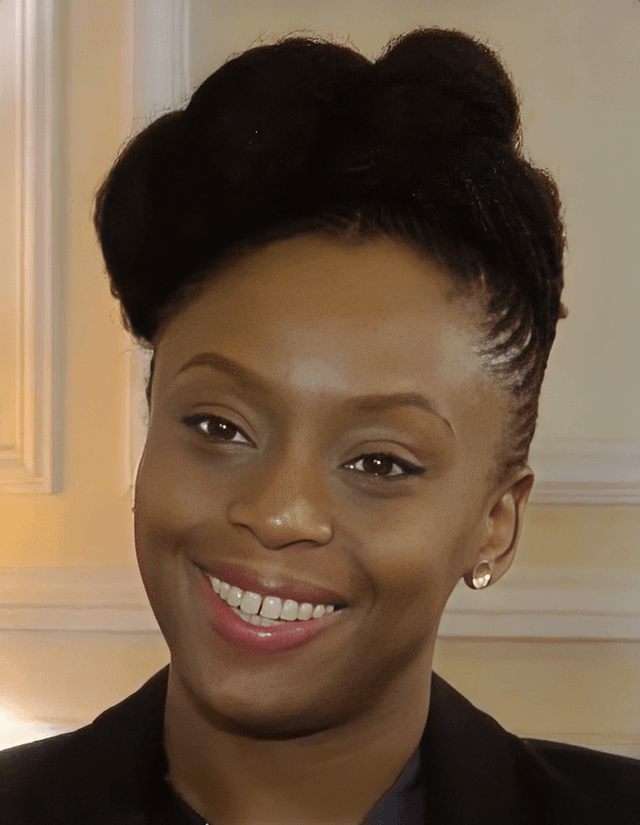
Wikimedia Commons / Lvklock / CC BY-SA 4.0
Chimamanda Ngozi Adichie
Award-winning Nigerian novelist and feminist icon. Author of Purple Hibiscus, Half of a Yellow Sun, Americanah, and the viral TED talk 'We Should All Be Feminists', which reached hundreds of millions of listeners after Beyoncé sampled it. One of the most influential voices on feminism, race, and African identity in the world today.
Biography
Grace Chimamanda Ngozi Adichie was born on 15 September 1977 in Enugu, Nigeria, and grew up in the university town of Nsukka, in Enugu State, where her father was a professor of statistics and her mother the first female registrar at the University of Nigeria. She grew up in the house previously occupied by Chinua Achebe, a detail she has described as formative, a silent inheritance.
She began writing early, producing her first stories as a child, stories that mirrored the British books she was reading: stories with English characters, snow at Christmas, blue eyes. It was only when she discovered African literature (Achebe, Ngugi, Flora Nwapa) that she understood she could tell stories that looked like her own life.
Adichie studied medicine and pharmacy at the University of Nigeria, Nsukka, for a year and a half before moving to the United States at age 19 to study communications and political science at Drexel University in Philadelphia. She later transferred to Eastern Connecticut State University, graduating summa cum laude. She went on to complete a master's in creative writing at Johns Hopkins University and a master's in African studies at Yale.
Historical Context
Adichie emerged as a writer at a moment when global publishing was dominated by Western voices and African literature was too often confined to postcolonial studies departments. She entered that space loudly, with Igbo names intact, Nigerian settings unapologised for, and a feminist politics that spoke both to African women and to the wider world. Her rise coincided with the explosion of social media, which allowed her work (particularly her TED talks) to spread far beyond traditional book audiences.
What She Fought For
Adichie has been a consistent, fearless voice for gender equality and African self-representation. Her 2012 TED talk We Should All Be Feminists dismantled the mythology around the word "feminist" and spoke directly to both African and global audiences. It was later published as a book and sampled by Beyoncé in Flawless (2013), introducing Adichie's thinking to hundreds of millions of listeners worldwide.
In 2014, the Swedish government distributed her essay to every 16-year-old in the country. In 2016, Dior printed "We Should All Be Feminists" on a T-shirt that sold worldwide.
She has spoken out on race in America, on the experience of being African in the West, on the need to raise children differently with respect to gender, and she has done so in a voice that is sharp, clear, and unwilling to be flattened into easy slogans.
Major Achievements
- Purple Hibiscus (2003), debut novel, Commonwealth Writers' Prize winner
- Half of a Yellow Sun (2006), set during the Biafran War; Orange Prize for Fiction winner
- The Thing Around Your Neck (2009), short story collection
- Americanah (2013), National Book Critics Circle Award; explores race, identity, and hair
- We Should All Be Feminists (2014), adapted from TED talk; distributed to every secondary school student in Sweden
- Dear Ijeawele (2017), feminist manifesto in letters
- MacArthur Fellowship ("Genius Grant") (2008)
- Inducted into the American Academy of Arts and Sciences (2017)
- Honorary degrees from Johns Hopkins, Yale, and multiple universities worldwide
Her Impact Today
Chimamanda Ngozi Adichie has reshaped the global conversation on feminism, Blackness, and what African literature can be. She splits her time between Nigeria and the United States, continuing to write and speak. Her influence on a generation of young Nigerian and African women writers (and young women globally) is immeasurable. She is, by most measures, the most read and most quoted African writer alive.
Sources: Wikipedia (Chimamanda Ngozi Adichie), The Guardian, TED.com, MacArthur Foundation
Know an African woman whose story should be here?
Suggest a woman