To the Mothers Who Gave Us Everything
A Mothering Sunday reflection on the African women who carried movements, raised revolutions, and wrote the truth, all while raising children who would inherit their courage.
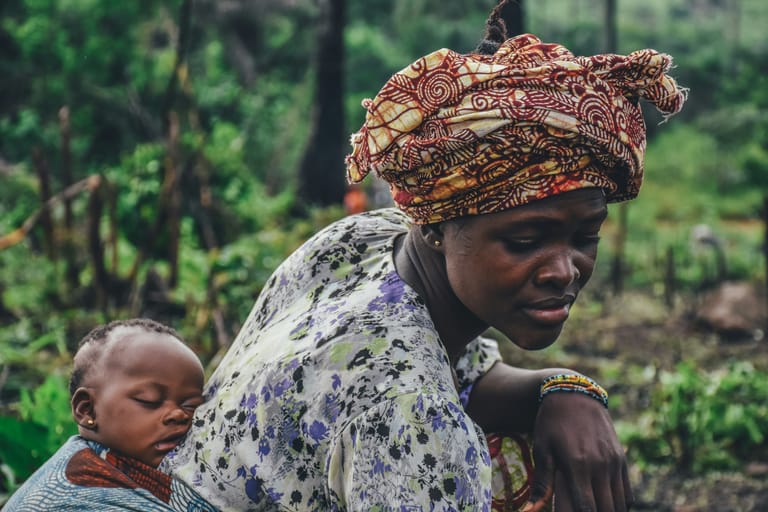
There is a kind of strength that doesn't announce itself. It doesn't give speeches or lead marches, though sometimes it does that too. It wakes up early. It stretches what little there is to cover what's needed. It holds a child with one arm and holds a world together with the other.
Your mother knows this strength. So does mine.
This is not a history lesson. It is a thank-you letter. To the mothers on this website who carried more than anyone should have to carry and still had enough left to give. And to the mothers reading this right now, and the mothers who raised the people reading this right now. The ones whose names will never be in any archive but whose work holds up everything.
She kept them alive
When Walter Sisulu was sentenced to life imprisonment alongside Nelson Mandela in 1964, the apartheid government believed they had removed the leaders. They had not accounted for the woman waiting at home.
Albertina Sisulu raised five children and three adopted ones while her husband spent 26 years on Robben Island. She did this under banning orders that restricted where she could go and who she could speak to. She did this while being arrested, again and again, sometimes simply for stepping outside her restricted area to attend to patients as a nurse.
She co-founded the United Democratic Front. She became one of the most important voices of resistance during apartheid's darkest years. She was elected to Parliament in the country's first free election in 1994.
And through all of it, every single day, she was a mother. Not as a footnote. As the foundation.
Walter Sisulu said of her: "She kept us alive."
He meant the family. He also meant the movement.
Mama Winnie
Winnie Madikizela-Mandela was 26 years old when her husband was taken to prison. She was left with two small daughters and a government that wanted her broken.
They banned her. They imprisoned her. They put her in solitary confinement. They sent her to a town where nobody spoke her language. And still, she did not disappear.
She raised her daughters. She organised her community. She turned her place of banishment into a clinic and a crèche. She became the face of resistance inside a country where every other leader was locked away or in exile.
Millions of South Africans called her Mama Winnie. Not because she was soft. Because she was there. She stayed when staying was the most dangerous thing a person could do, and she mothered a nation that needed someone to hold it together when everything was falling apart.
She rewrote it
Buchi Emecheta arrived in London from Lagos in the early 1960s with small children, no money, and a marriage that was coming undone.
She had been writing. Late at night, after the children were asleep, she was putting words on paper. When her husband found the manuscript, he burned it.
She rewrote it.
He burned it again.
She rewrote it again.
She eventually left the marriage and raised five children alone in a city that did not make it easy to be Black, female, Nigerian, and poor. She worked. She studied. She earned a degree. And she kept writing, always after the children were in bed, always with whatever time was left.
She wrote eighteen novels. She was honoured with an OBE. The Joys of Motherhood, Second Class Citizen, Destination Biafra. Books now taught in universities around the world, written at kitchen tables, in small hours, by a woman who had every reason to stop and never did.
When someone asks what it costs to tell the truth, Buchi Emecheta is the answer: everything, twice, and then you write it again.
Nine children and two books that changed everything
Mariama Bâ was a schoolteacher in Senegal. She was divorced. She was raising nine children alone.
She wrote a novel. She called it So Long a Letter. It is written as a letter from one woman to another, and it tells the truth about what polygamy does to a woman's life, not as a political argument but as a lived experience, rendered with the quiet devastation of someone who knows because she lived it.
It won the first ever Noma Award for African literature. It changed West African writing permanently. It is still read in schools and universities across the world.
She wrote a second novel, Scarlet Song, published shortly before her death in 1981. She was 52 years old.
Two books. Nine children. A life that was far too short, and a legacy that will outlast most writers who had decades more and carried far less.
Sometimes the measure of what a mother gives is not in what she had but in what she made from what was left.
The mother who raised a revolution
Funmilayo Ransome-Kuti led a mass women's movement that forced out a king, abolished colonial taxation in Abeokuta, and changed how Nigerian women saw their own power. She was the first Nigerian woman to vote. She represented her country at international conferences around the world. She received the Lenin Peace Prize.
She was also a mother.
Her son, Fela Anikulapo-Kuti, became one of the most important musicians Africa has ever produced. His politics, his defiance, his absolute refusal to be quiet. None of it came from nowhere. He grew up watching his mother organise 100,000 women to demand their rights. He watched her stare down colonial authorities and win. He watched her refuse to accept anything less than justice.
Everything Fela became started in that house, with that mother.
In 1977, Nigerian soldiers raided Fela's compound. They threw Funmilayo from an upstairs window. She never recovered. She died the following year, at 77.
She gave Nigeria one of its greatest voices. She gave African women a blueprint for political organising that is still used today. And she gave everything she had, including, in the end, her life.
The ones we call "Mother"
It says something that so many of the women on this website have earned the title "Mother" from the people they served. Not because they bore children, though some did, but because they gave something only mothers give: a beginning. A first step. A door that had never been opened before, held open for everyone who came after.
Charlotte Maxeke, the first Black South African woman to earn a university degree, is called the "Mother of Black Freedom in South Africa." She founded the Bantu Women's League, fought pass laws, and spent her life building foundations that others would stand on long after she was gone.
Flora Nwapa, the first African woman to publish a novel through a major international publisher, is called the "Mother of Modern African Literature." She didn't just write the first book. She founded her own publishing house so that other African women could write theirs.
They were called "Mother" because the word means more than biology. It means: she made something possible that did not exist before her.
What she planted
Wangari Maathai planted seven trees in her backyard in 1977. By the time she died, her Green Belt Movement had planted over 51 million trees across Africa and won her the Nobel Peace Prize.
She was also a mother. Her daughter, Wanjira Mathai, continues the environmental work today.
There is something in that image. A mother planting trees she may never sit under, for a world her daughter will inherit. That captures what so many of the women on this website gave. They built for the next generation. They fought so that their children, and everyone else's children, would have more than they did.
That is what mothers do. Not always loudly. Not always with recognition. But always forward.
To them, and to you
The women in this article did extraordinary things. But if you are a mother reading this, you already know the weight they carried. You know what it is to give more than you have. You know what it means to be tired in a way that sleep does not fix and to get up the next morning anyway because someone is depending on you.
Maybe you wrote no novels. Maybe you led no marches. But you showed up. You made a way where there wasn't one. You turned nothing into something so many times that your children grew up thinking that's just how the world works, not realising it only worked because you made it work.
That is not a small thing. That is the biggest thing there is.
So this is for Albertina and Buchi and Mariama and Funmilayo and Winnie and Charlotte and Flora and Wangari. But it is also for your mother. And my mother. And for every mother reading this who has never once been thanked the way she deserves.
Thank you.
For the meals that appeared like magic. For the school fees you found when there was no money. For the prayers you whispered when you thought nobody was listening. For the times you were afraid and never let it show. For all the things you gave up that we will never know about because you never told us.
You gave us everything. We are still living on it.
Happy Mothering Sunday.
What to take away
- Albertina Sisulu raised eight children while her husband was imprisoned for 26 years, and still became one of the most important leaders of the anti-apartheid movement. Walter Sisulu said of her: "She kept us alive."
- Buchi Emecheta wrote eighteen novels while raising five children alone in London, after her husband burned her manuscripts. Twice.
- Mariama Bâ raised nine children as a single mother and wrote two books that changed West African literature. She died at 52.
- Funmilayo Ransome-Kuti raised Fela Kuti while leading Nigeria's most powerful women's political movement. She gave everything, including her life.
- Charlotte Maxeke and Flora Nwapa are called "Mother" of Black freedom and African literature because they opened doors no one had opened before and held them open for others.
- Wangari Maathai planted trees for a future her daughter now carries forward.
- Motherhood in Africa has never been small and has never been separate from the story of resistance, creativity, and change. It has always been at the centre.
- The mothers in the history books and the mothers in our homes are carrying the same weight. Both deserve to be seen, thanked, and honoured.