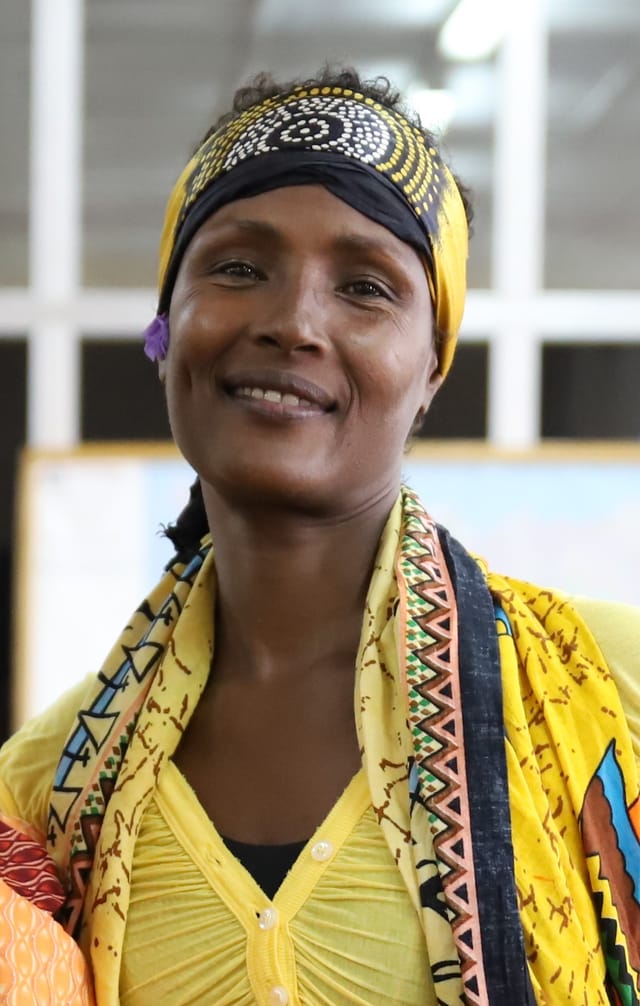
Wikimedia Commons / Desert Flower Foundation / CC BY-SA 4.0
Waris Dirie
Somali-born supermodel turned United Nations Special Ambassador who transformed her personal trauma of FGM into a global campaign. Her memoir Desert Flower sold 12 million copies and became an internationally released film. Founder of the Desert Flower Foundation, which has reached millions of women and girls worldwide in the fight to end female genital mutilation.
Biography
Waris Dirie was born in 1965 (approximate) in the Somali desert, the daughter of a nomadic herder. She was one of twelve children. At age five, she underwent female genital mutilation at the hands of a wandering circumciser, a practice she would later describe in harrowing detail in her memoir, and which would define the mission of the rest of her life.
At age 13, her father arranged for her to marry a 60-year-old man in exchange for five camels. She fled alone across the desert, barefoot, to her grandmother's home in Mogadishu. Eventually she made her way to London, where she worked as a domestic servant for her uncle, a Somali diplomat.
When the embassy assignment ended and her uncle returned to Somalia, Dirie was left alone in London, undocumented, with no money and almost no English. She survived, and then, by one of the stranger pivots in modern history, she was discovered by a photographer on a London street and launched into one of the most successful modelling careers of the 1980s and 1990s.
Historical Context
FGM (female genital mutilation) affects an estimated 200 million women and girls alive today across 30 countries, predominantly in Africa. It ranges in severity from partial clitoridectomy to infibulation (removal of the clitoris, labia, and sewing of the vaginal opening). It causes chronic pain, complications in childbirth, and long-term psychological trauma. It is performed on girls, often pre-pubescent, without their consent.
For decades, it was treated in the West as a cultural matter, not to be judged or interfered with. In many affected communities, it was (and remains) normalised and enforced by women on girls.
Waris Dirie broke the silence.
What She Fought For
In 1997, at the peak of her modelling career, Dirie agreed to be interviewed by Marie Claire magazine and publicly described her experience of FGM for the first time. The interview was a bombshell. That same year, the United Nations appointed her Special Ambassador for the Elimination of Female Genital Mutilation, making her the first global public figure to make FGM the centre of their advocacy.
Her 1998 memoir Desert Flower sold 12 million copies in 50 countries. It was adapted into a major international film in 2009. She followed it with Desert Dawn (2002) and Desert Children (2005), in which she focused specifically on FGM and the girls living under its threat.
She founded the Desert Flower Foundation in 2002, which runs education and medical programmes across Africa and Europe, funds reconstructive surgery for survivors, and works with governments to change laws and social norms around FGM.
Major Achievements
- UN Special Ambassador for the Elimination of Female Genital Mutilation (appointed 1997)
- Desert Flower memoir (1998), 12 million copies sold, 50 countries, film adaptation (2009)
- Founder, Desert Flower Foundation (2002)
- First global public figure to bring FGM into mainstream international discourse
- Modelled for Chanel, L'Oréal, Revlon, Levi's; appeared on the cover of Vogue
- Glamour Woman of the Year, United States
- Led international advocacy that contributed to multiple national bans on FGM
Her Impact Today
Waris Dirie's advocacy helped shift the global conversation on FGM from a cultural practice to a human rights violation. The number of countries with laws against FGM has grown significantly since the late 1990s, and international pressure (much of it traceable to the awareness she raised) has contributed to a measured but real decline in prevalence in several countries.
The Desert Flower Foundation continues to operate programmes in Somalia, Kenya, Egypt, Tanzania, Senegal, and across Europe. FGM has not been eliminated. But it is no longer unspeakable. Waris Dirie made sure of that.
Sources: Wikipedia (Waris Dirie), Desert Flower Foundation, UNFPA, Marie Claire, The Guardian
Know an African woman whose story should be here?
Suggest a woman