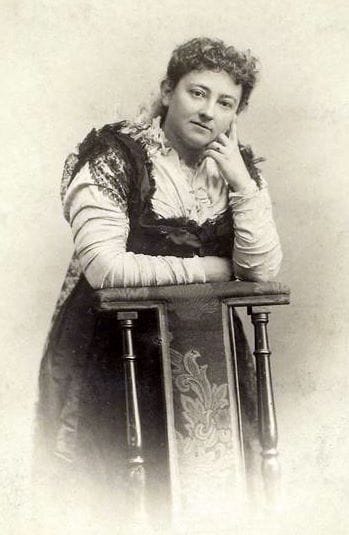
Wikimedia Commons / Public Domain
Olive Schreiner
South African novelist and political activist who wrote The Story of an African Farm in 1883, one of the first great feminist novels in English. She spent her life fighting for women's rights, opposing racism and the Boer War, and insisting that the world she lived in was unjust. Over a century before second-wave feminism, she was already asking the same questions.
Biography
Olive Emilie Albertina Schreiner was born on 24 March 1855 at the Wittebergen mission station in what is now the Eastern Cape, South Africa. She was the ninth of twelve children of a German missionary father and an English mother. She grew up in the harsh landscape of the South African frontier, largely self-educated through voracious reading.
She began writing The Story of an African Farm as a teenager, drawing on the landscape and people around her. She travelled to England in 1881 to try to publish it and, after several rejections, it was published in 1883 under the male pseudonym Ralph Iron. It was an immediate sensation. The novel's protagonist, Lyndall, is one of the most remarkable female characters in Victorian-era fiction: a woman who refuses to accept the role society assigns her, who speaks about gender injustice with a directness that was radical for its time.
She returned to South Africa and became involved in politics. She was a fierce opponent of the Boer War (1899 to 1902), opposing the violence on both sides. She was also a critic of Cecil Rhodes and the racist colonial project in southern Africa. She wrote Woman and Labour (1911), a major feminist text that influenced the suffragette movement in Britain and beyond.
What She Fought For
Schreiner fought against every form of domination she could see: the domination of women by men, of Black people by white colonisers, of subject peoples by empires. She did not pick one cause. She understood them as connected.
She was ahead of her time in almost every direction. She argued for women's sexual autonomy in an era when respectable women were not supposed to have desires. She opposed racism and segregation in a settler colony where those were the foundations of society. She opposed the Boer War when it was popular. She wrote about the inner lives of women at a time when women's inner lives were considered irrelevant.
Major Achievements
- Author of The Story of an African Farm (1883), one of the foundational feminist novels in English literature
- Author of Woman and Labour (1911), influential on the suffragette movement internationally
- One of the first major voices to connect feminism and anti-imperialism in African literature
- Her work is studied in literature courses around the world
- The Olive Schreiner Literary Award, South Africa's most prestigious literary prize, is named in her honour
Her Impact Today
Olive Schreiner died in 1920, but her questions have not gone away. She asked what women were for and refused to accept the answers she was given. She asked what colonialism was doing to people and refused to look away. She wrote those questions into fiction and political essays that are still read today. She is one of the founding voices of South African literature and African feminism, even though she never used that last word.
Sources: Wikipedia (Olive Schreiner), The Story of an African Farm (1883), Woman and Labour (1911), South African Literary Awards
Know an African woman whose story should be here?
Suggest a woman