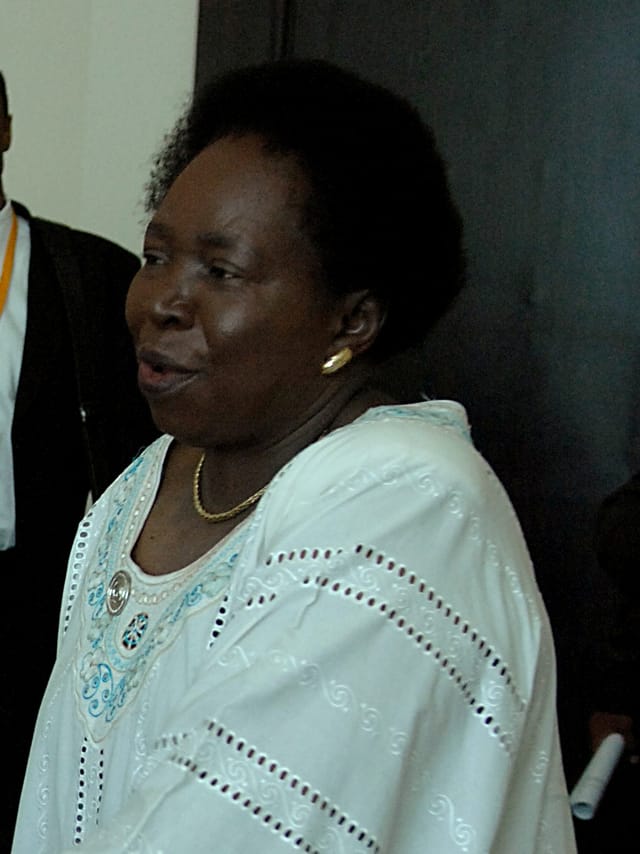
Wikimedia Commons / CC BY-SA 2.0
Nkosazana Dlamini-Zuma
South African politician and physician who served as the first woman Chairperson of the African Union Commission, having previously led South Africa's transformation of its healthcare system as Minister of Health.
Biography
Nkosazana Clarice Dlamini-Zuma was born on 27 January 1949 in Pietermaritzburg, KwaZulu-Natal, South Africa. She grew up under apartheid and became politically active as a student, joining the South African Students' Organisation (SASO) and the ANC underground while studying at the University of Zululand.
Forced into exile by the apartheid regime, she completed her medical degree at the University of Bristol in the United Kingdom. During her years in exile, she worked in ANC health structures in Swaziland, Mozambique, and Tanzania, providing medical care to refugees and fellow exiles.
After the end of apartheid, she returned to South Africa and entered government, serving in some of the most powerful cabinet positions in the new democracy.
Historical Context
South Africa's transition from apartheid to democracy in 1994 required not just political change but the complete transformation of state institutions — including a healthcare system that had been designed to serve the white minority. The new government needed leaders who understood both the technical demands of governance and the political imperatives of the liberation struggle.
At the continental level, the African Union was evolving from a club of heads of state into an institution with ambitions to drive Africa's economic and political integration. The AU Commission chairpersonship became a position of real influence.
What She Fought For
As South Africa's Minister of Health (1994–1999), Dlamini-Zuma led the overhaul of the apartheid-era healthcare system, expanding primary healthcare access to millions of Black South Africans for the first time. She introduced free healthcare for pregnant women and children under six, and championed the Tobacco Products Control Act, making South Africa a global leader in anti-tobacco legislation.
She later served as Minister of Foreign Affairs (1999–2009), shaping South Africa's post-apartheid foreign policy and its role in African peacekeeping. In 2012, she was elected Chairperson of the African Union Commission — the first woman to hold the position — where she championed Agenda 2063, the AU's long-term development framework.
Major Achievements
- First woman elected Chairperson of the African Union Commission (2012–2017)
- Transformed South Africa's healthcare system as Minister of Health (1994–1999)
- Introduced free healthcare for pregnant women and children under six
- Led South Africa's foreign policy as Minister of Foreign Affairs for a decade
- Championed the AU's Agenda 2063 development framework
- Anti-apartheid activist and exile who served in ANC health structures across Southern Africa
Her Impact Today
Nkosazana Dlamini-Zuma's career spans the full arc of South Africa's modern history — from anti-apartheid resistance to governing a democracy to leading the continent's premier political institution. Her election as AU Commission chair broke a glass ceiling and demonstrated that African women could lead at the highest levels of continental governance.
Sources: Wikipedia (Nkosazana Dlamini-Zuma), African Union Commission, South African Government archives
Know an African woman whose story should be here?
Suggest a woman