Wikimedia Commons / Public Domain
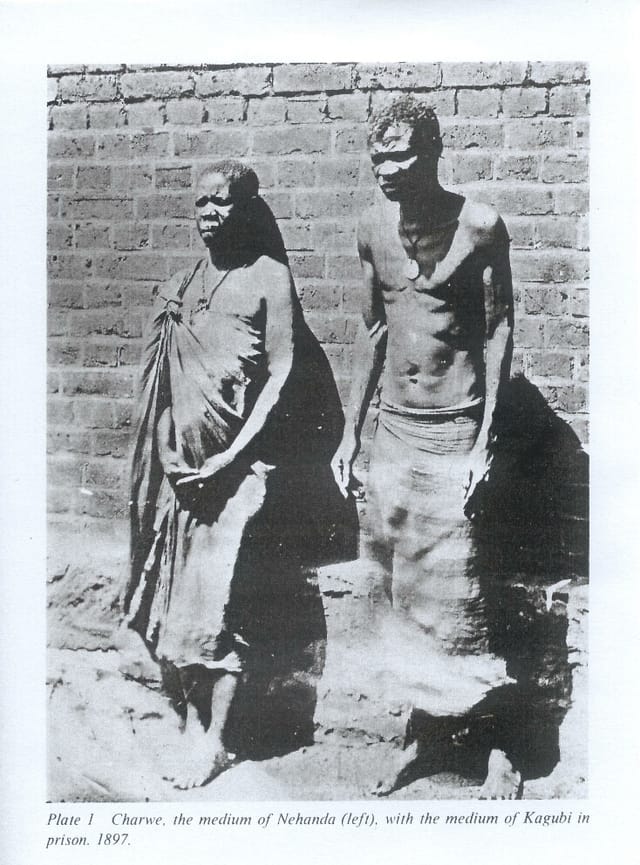
Nehanda Charwe Nyakasikana
Zimbabwean spirit medium and revolutionary leader who commanded the First Chimurenga uprising against British colonisation. Her last words, 'my bones will rise,' became the rallying cry of Zimbabwe's independence movement 80 years later.
Biography
Nehanda Charwe Nyakasikana, also known as Mbuya Nehanda, was born around 1840 in Chishawasha, Mashonaland, in the territory that is now Zimbabwe. She was a svikiro, a spirit medium believed to be possessed by Nehanda, a powerful female ancestral spirit of the Shona people.
Among the Zezuru Shona, spirit mediums held enormous authority: they advised chiefs, settled disputes, and communicated the will of the ancestors. Nehanda was not a queen in the European sense. She was something more difficult to understand from the outside, and more dangerous from the inside: a woman through whom the ancestors spoke.
Historical Context
In 1889, Cecil John Rhodes' British South Africa Company arrived in Mashonaland, claiming land by treaty and by force. The Shona people, who had governed the region for centuries, found their cattle seized, their labour conscripted, and their land appropriated for white settlers.
The administrator Henry Harwood Polling was particularly brutal in extracting taxes and labour from Shona communities in Nehanda's area. He became a direct target.
What She Fought For
In 1896–1897, Nehanda became one of the spiritual and military leaders of the First Chimurenga, the uprising of the Shona and Ndebele peoples against British colonial rule. She organised communities, provided spiritual authority to fighters, and is credited with directing the killing of Polling.
She fought for the return of land, the expulsion of colonial forces, and the right of her people to govern themselves under their own law and tradition. The uprising was eventually suppressed by British forces with superior weapons.
Nehanda was captured in 1897. When offered a reprieve if she converted to Christianity, she refused. She was hanged in Salisbury (now Harare) on 27 April 1898.
Her reported last words were: "My bones will rise again."
Major Achievements
- Led one of the earliest armed resistance movements against British colonisation in southern Africa
- Her spiritual authority united communities across Mashonaland in organised resistance
- Became the defining symbol of Zimbabwean nationalist identity and liberation struggle
- Her name and image became central to the Second Chimurenga, Zimbabwe's independence war of the 1970s
Her Impact Today
Eighty years after her execution, guerrilla fighters in Zimbabwe's liberation war invoked Nehanda's name and spirit for courage. Songs were written about her. The liberation movement carried her memory the way soldiers carry flags.
In 2021, Zimbabwe unveiled a large statue of Nehanda in central Harare. In a country where most public statues are of colonial figures, her presence in the capital is a statement.
Her bones, as she promised, did rise.
Sources: Wikipedia (Nehanda Charwe Nyakasikana), Zimbabwe National Archives, Encyclopædia Britannica
Know an African woman whose story should be here?
Suggest a woman