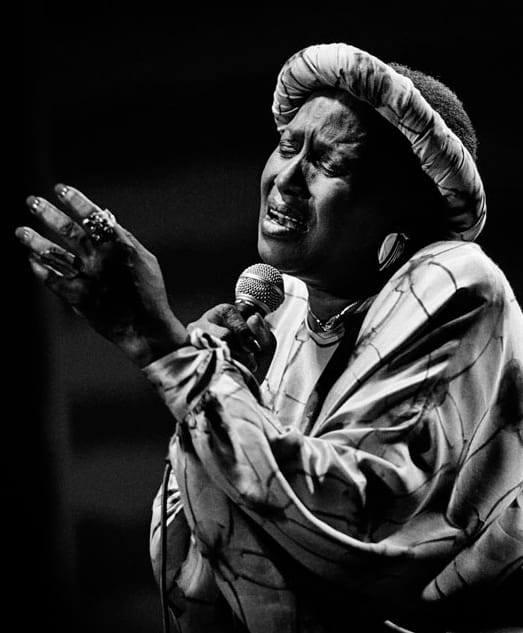
Wikimedia Commons / Public Domain
Miriam Makeba
South African singer and activist known as 'Mama Africa' who used music as a weapon against apartheid, addressed the United Nations, and was exiled from her homeland for 31 years.
Biography
Zenzile Miriam Makeba was born on 4 March 1932 in Prospect Township, Johannesburg, to Swazi and Xhosa parents. Her father died when she was six; she spent time in prison as an infant, strapped to her mother's back while her mother served time for illegally brewing traditional beer.
She began singing professionally in the 1950s, joining the Manhattan Brothers and later The Skylarks. Her performance in the anti-apartheid film Come Back, Africa (1959) brought her to international attention and marked the beginning of her life as both artist and activist.
Historical Context
Apartheid South Africa criminalised not only resistance but ordinary Black life. The pass laws, the forced removals, the banning of interracial relationships: all of it formed the backdrop of Makeba's early life. Black artists could perform for white audiences but could not eat in the same restaurants or stay in the same hotels.
When Makeba left South Africa to attend the London premiere of Come Back, Africa in 1959, the South African government revoked her passport. She could not return for her mother's funeral. She would not set foot in South Africa again for 31 years.
What She Fought For
Makeba testified before the United Nations Special Committee on Apartheid in 1963, becoming one of the first artists to directly lobby the international community to impose sanctions on South Africa. Her testimony contributed to the arms embargo against the apartheid regime.
She used every stage, every interview, every performance to speak about apartheid when much of the world was still doing business with Pretoria. Her marriage to Black Panther leader Stokely Carmichael in 1968 cost her American concert bookings and record deals. She bore that cost without apology.
She lived in exile in Guinea under President Sékou Touré, and later in Belgium and the United States. Wherever she went, she carried Africa with her.
Major Achievements
- First African artist to win a Grammy Award (1965, shared with Harry Belafonte)
- Addressed the United Nations Special Committee on Apartheid (1963)
- Ambassador to the UN for Guinea and Belize
- UNESCO Goodwill Ambassador
- Returned to South Africa in 1990 at Nelson Mandela's personal invitation
- Performed until her death: she died on stage in Italy in 2008
Her Impact Today
Miriam Makeba proved that culture is politics. Her songs (Pata Pata, Malaika, the Click Song) brought Africa to the world, but she never let the world forget what was happening to Africans. She died performing at a concert in solidarity with Italian writer Roberto Saviano, who had received death threats for exposing the Camorra.
She died the way she lived: in the middle of a fight, still singing.
Sources: Wikipedia (Miriam Makeba), Grammy Foundation, UNESCO
Know an African woman whose story should be here?
Suggest a woman