Wikimedia Commons / Public Domain
Umm Kulthum
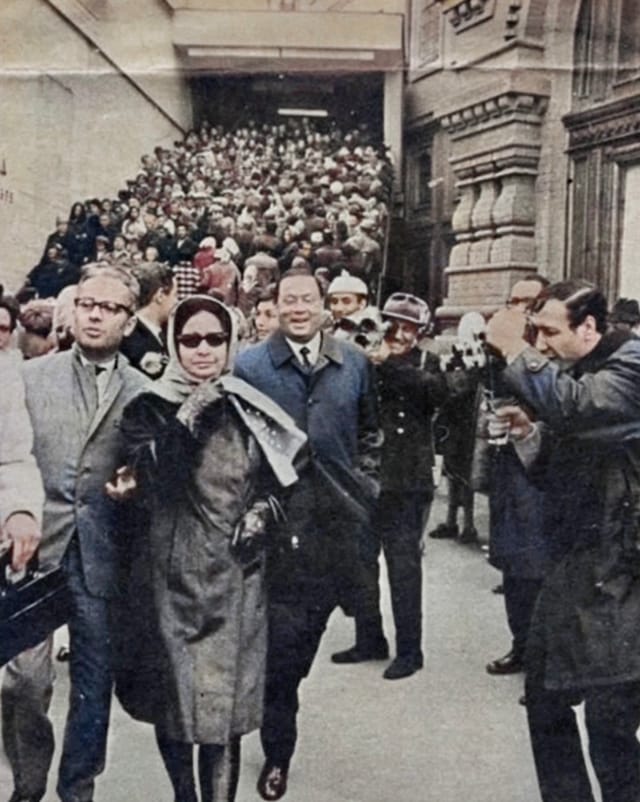
Egyptian singer known as the Star of the East and the most famous Arab singer of the 20th century. Born around 1898 in a small Delta village, she rose to become a cultural icon whose concerts lasted four to six hours. Her funeral in 1975 drew four million mourners, a crowd larger than that for Nasser.
Biography
Umm Kulthum was born around 1898 in the village of Tamay ez-Zahayra in the Nile Delta, Egypt. Her father was an imam who sang at religious ceremonies; she learned to sing by mimicking him. As a child she dressed as a boy to perform in public, since it was not acceptable for girls to sing before mixed audiences.
She moved to Cairo in the 1920s and quickly became the dominant voice of Arabic music. She worked with the finest poets and composers of the era. Her concerts were legendary: she would sing a single song for an hour or more, improvising and repeating phrases until the audience was transported. She performed for kings, presidents, and millions of ordinary people across the Arab world.
Historical Context
Umm Kulthum's career spanned the end of colonial rule in Egypt, the rise of Arab nationalism, and the birth of the modern Middle East. Radio brought her voice into every home. She became a symbol of Arab identity and pride at a time when the region was redefining itself.
She was close to Egyptian President Gamal Abdel Nasser, who broadcast her monthly concerts live on the radio. When she sang, the streets of Cairo emptied. She was more than a singer; she was a unifying force across class, religion, and nationality.
What She Fought For
Umm Kulthum fought for the dignity of Arabic culture and the place of women at its centre. She refused to be confined to the private sphere. She built a career on her own terms, controlled her repertoire, and demanded respect from poets, composers, and politicians alike.
She also used her platform for political and social causes. She performed for Egyptian troops during the 1948 and 1967 wars and donated proceeds to the Egyptian government. She sang of love, loss, and longing in a way that spoke to the collective experience of the Arab world. Her voice became the sound of a people.
Major Achievements
- The most famous and influential Arab singer of the 20th century
- Known as Kawkab al-Sharq (Star of the East) and Sayyidat al-Ghina al-Arabi (Lady of Arabic Song)
- Monthly radio concerts drew tens of millions of listeners across the Arab world
- Collaborated with the greatest Arab poets and composers of her era
- Her funeral in 1975 drew an estimated four million mourners
- Her music remains central to Arab cultural identity today
Her Impact Today
Umm Kulthum is still heard in cafes, taxis, and homes across the Arab world and beyond. She defined what Arabic song could be: emotionally vast, technically demanding, and deeply rooted in tradition while reaching toward the universal. She proved that a woman could be the greatest artist of her culture and the voice of a nation. Her legacy endures in every singer who has followed her.
Sources: Wikipedia (Umm Kulthum), Virginia Danielson, The Voice of Egypt: Umm Kulthum, Arabic Song, and Egyptian Society in the Twentieth Century
Know an African woman whose story should be here?
Suggest a woman