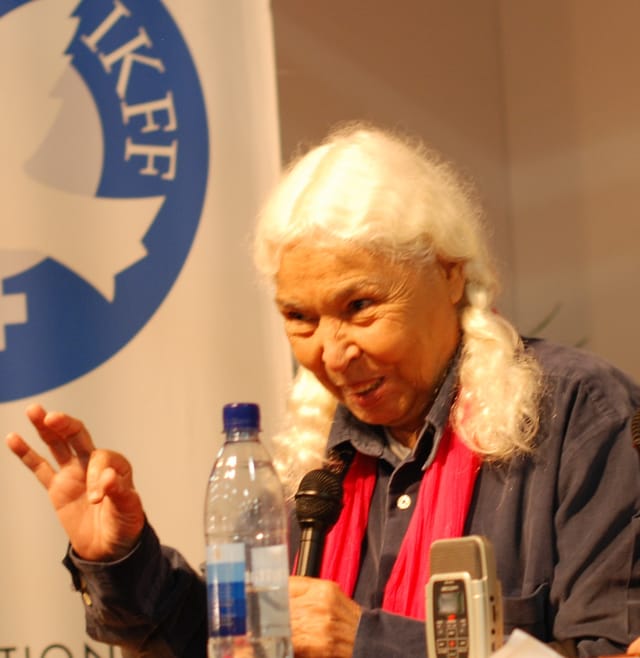
Wikimedia Commons / Public Domain
Nawal El Saadawi
Egyptian feminist writer, psychiatrist, and activist who spent five decades fighting patriarchy, religious conservatism, and female genital mutilation at great personal cost: losing her job, being imprisoned, and living under death threats. Author of over 50 books translated into more than 30 languages. Called 'the Simone de Beauvoir of the Arab world.'
Biography
Nawal El Saadawi was born on 27 October 1931 in Kafr Tahla, a village in the Nile Delta, Egypt. Growing up in a rural setting shaped her understanding of the conditions most Egyptian women lived under: conditions of poverty, lack of education, early marriage, and female genital mutilation (FGM). She refused to accept those conditions as natural or inevitable.
She trained as a physician at Cairo University, graduating in 1955, and went on to specialise in psychiatry. She rose to become Director of Public Health at the Egyptian Ministry of Health. But her professional career was about to become a battleground.
Historical Context
Egypt in the 1950s–1970s was undergoing rapid modernisation under Nasser and Sadat, but the position of women, particularly regarding sexuality, bodily autonomy, and political participation, remained profoundly constrained. Religious conservatism and patriarchal norms were deeply embedded in law, medicine, and culture. FGM was widely practised and rarely discussed publicly. Women who raised these issues did so at serious professional and personal risk.
Nawal El Saadawi raised them anyway.
What She Fought For
In 1972, El Saadawi published Women and Sex (Al-Mar'a wa-l-Jins), a medical and social analysis of women's bodies, sexuality, and the damage done by FGM and patriarchal culture. The book was explosive. The Egyptian Medical Association revoked her position at the Ministry of Health. She was dismissed from her job. The book was banned.
She kept writing. Over the following decades she produced more than 50 books (novels, memoirs, essays, and academic work) that systematically dissected the intersections of religion, sex, power, and women's oppression in the Arab world. Her novel Woman at Point Zero (1975), based on interviews she conducted in Qanatir Prison with women on death row, became one of the most widely read Arabic feminist novels in the world.
In 1981, President Sadat had her imprisoned for three months without charge. She wrote about the experience in Memoirs from the Women's Prison. Under Mubarak, she lived under death threats from Islamist groups and was kept on a government "death list."
She co-founded the Arab Women's Solidarity Association in 1982, which was later shut down by the Egyptian government. She continued to speak, write, and travel, unsilenced.
In 2011, at age 79, she went to Tahrir Square during the Egyptian Revolution and took part in the protests. She said simply: it was her duty.
Major Achievements
- Author of more than 50 books in Arabic, translated into more than 30 languages
- Woman at Point Zero (1975): landmark feminist novel
- The Hidden Face of Eve (1977): foundational text on women in the Arab world
- Women and Sex (1972): banned; cost her her career; changed Arab feminist discourse permanently
- Co-founder, Arab Women's Solidarity Association (1982)
- Catalonia International Prize, 2003
- North–South Prize of the Council of Europe, 2004
- Honorary doctorates from universities worldwide including University of Chicago, University of York
- BBC 100 Women (2015)
Her Impact Today
Nawal El Saadawi died on 21 March 2021, aged 89. She had never stopped writing, speaking, or demanding. Her work created the vocabulary for Arab feminist discourse and gave generations of women in Egypt and across the region permission to name what had been done to them and to demand something different. Egypt has still not banned FGM absolutely. But the conversation she forced into the open in 1972 cannot be closed.
She was ferocious, uncompromising, and irreplaceable.
Sources: Wikipedia (Nawal El Saadawi), Encyclopædia Britannica, The Guardian, Zed Books (publisher), Al Jazeera
Know an African woman whose story should be here?
Suggest a woman